Federal agencies managed more than $6.8 trillion in funding in 2024, much of it still moving through financial systems built decades ago. The Financial Management Quality Service Management Office (FM QSMO) is working to change that with a curated marketplace of vetted, standards-based financial systems and services. A December 2025 report from the Government Accountability Office confirms the effort is gaining ground. It also makes clear the office faces real headwinds and that technology alone will not be sufficient for agencies to achieve their missions. Success depends on how well agencies modernize around aging systems, integrate the platforms finance touches, and bring their people along.
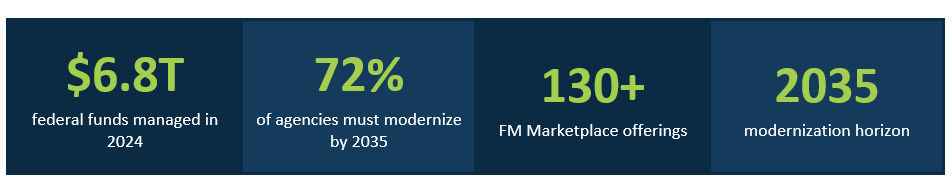

The biggest obstacle is also the most familiar. Many CFO Act agencies still run end-of-life, on-premise financial systems, and FM QSMO estimates that 72 percent of them will require significant modernization by 2035. Replacing acore financial system is rarely quick or cheap; it can stretch across years and cost hundreds of millions of dollars. So agencies delay, technical debt compounds, and security and compliance grow harder to maintain. The agencies that move fastest tend to modernize around the core rather than ripping it out, connecting and refactoring the custom applications that surround the ERP so operations keep running while the foundation is rebuilt.

A financial system never operates on its own. It connects to procurement, travel, payroll, grants, property, human resources, budget, and Treasury payment systems. Standardizing finance without coordinating those adjacent systems is where modernization projects tend to bog down, and GAO named cross-functional coordination one of the effort’s defining challenges. Clean handoffs between finance and everything it touches, built on interoperable data and modern identity, are what turn a collection of systems into a working whole and let agencies exchange data seamlessly across grants, HR, acquisition, and payments.

Federal financial systems are always adapting. New OMB guidance, Treasury standards, G-Invoicing, payment integrity rules, cybersecurity mandates, and emerging AI governance all mean constant change, and FM QSMO refreshes its Financial Management Capability Framework every year to keep pace. Agencies increasingly want AI to help with reconciliations, invoice classification, forecasting, and payment anomaly detection, but they need it grounded in their own data and fully auditable. Deployed with the right governance and security controls, AI moves financial oversight upstream, from recovering losses after payment to catching them before the money moves.

Even the best marketplace only helps if agencies use it.
GAO found awareness remains uneven: financial managers often know the Marketplace exists, while the contracting and acquisition officials who actually procure solutions frequently do not. Adoption is still in its infancy, and federal shared services have not always delivered the efficiencies they promised, so agencies are remaining cautious. Closing that gap will take more than a catalog. It will take clear communication, training, and deliberate change management so the people expected to use new systems actually do.

FM QSMO is not simply deploying software; it has to show that marketplace adoption lowers costs, speeds implementations, strengthens internal controls, and improves reporting. That case is far easier to make when leaders can see it. Real-time dashboards that surface budget execution, improper payments, spending trends, and payment status give agency leadership the line of sight to make faster, better-informed decisions, and give the whole effort the evidence it needs to build momentum.

Financial systems hold some of the most sensitive data in government and moving to shared, cloud-based providers raises the stakes. Zero Trust architecture, modern identity and privileged-access management, continuous monitoring, and FedRAMP-ready environments are becoming table stakes rather than enhancements. Security built in from the start, rather than bolted on later, is what lets agencies adopt shared services with confidence and keeps payment integrity front and center.
Financial modernization is no longer just an ERP project. It is an enterprise transformation initiative spanning data, integration, security, AI, and the people who make it all work. The agencies that succeed in the FM Marketplace will be the ones that treat it that way, and the partners who help most will modernize legacy applications, connect finance to everything around it, secure the data, and support staff through the culture change.

CMMI/DEV-3;
ISO 9001:2015;
ISO 20000-1:2018;
ISO 27001:2022 certified
CAGE CODE: 1XS43
UEID: YXWBLMDJX2E6